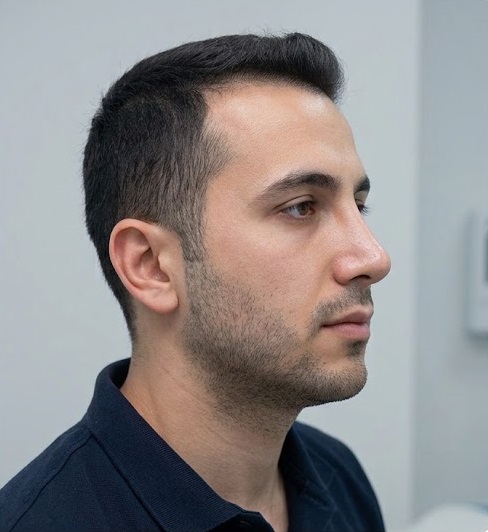
Male patients usually seek rhinoplasty for two reasons: a crooked nose after trauma or a prominent hump together with breathing difficulty, and a profile they find bothersome. The shared expectation is almost always the same: the nose should be corrected but must not look "operated on" or feminine. On this page I describe the anatomical differences of the male nose and how planning is adapted to them.
Anatomical features of the male nose
There are structural differences between male and female noses that directly affect planning:
- The skin is thicker and oilier. Especially at the tip, thick skin hides fine detail; defining the tip requires more structural support and swelling lasts longer.
- The cartilages are stronger and the bony vault wider. This means better support, but hump and width corrections can be more extensive.
- The nose is generally longer and more projected. It is in balance with the other features of the face (a prominent chin, brow ridge); reducing it enough to disturb this balance makes the face look out of proportion.
The aesthetic goals are different
The slightly curved bridge and rotated tip often preferred in female rhinoplasty usually look artificial on a male face. The basic planning principles for male patients are:
- A straight or very slightly curved bridge: the hump is removed but the bridge is not scooped; the profile stays straight.
- Less tip rotation: the angle between the tip and the upper lip is kept narrower in men; the tip is not lifted excessively.
- Preserved projection: the nose is not reduced more than necessary; a size in harmony with the strong features of the face is the aim.
- A defined but not delicate tip: the tip is given definition under thick skin while a fine, pointed look is avoided.
These principles are not a template; every face is assessed on its own and expectations are discussed together during the examination.
Common situations
- Crooked nose after trauma: sports injuries and accidents are more frequent in men. The deviation usually comes with a deviated septum; the bony vault and septum are corrected in the same operation.
- Prominent hump: the hump of bone and cartilage is removed so that the profile stays straight; see the Dorsal Hump page for details.
- Breathing difficulty: septal, turbinate and valve problems are a frequent reason for consultation in male patients; functional correction becomes part of the plan.
Examination and planning
During the examination skin thickness, cartilage strength, and the width and symmetry of the bony vault are assessed; in patients with breathing complaints the inside of the nose is examined with an endoscope. Profile planning is done on photographs; this lets us discuss how a change will look on the face, without promising the outcome. Patients with thick skin are told specifically that the change at the tip may be more limited and that swelling will last longer.
Surgery and afterwards
The operation is performed under general anaesthesia; the technique (open or closed) is chosen according to the procedures planned. The piezo technique can be used to reshape a wide bony vault. Tip support is usually reinforced with cartilage grafts to provide definition under thick skin.
The post-operative course is generally the same as for rhinoplasty in general: a splint for about a week, swelling and bruising in the first days. In thick skin, tip swelling takes longer to subside; the final shape may take up to a year to settle. Return to physical activity and contact sports is decided at follow-up visits; the period of protecting the nose from impact while the bones heal is explained individually.
This page is for general information; planning is done during examination. For other topics see Rhinoplasty: Overview; to arrange an appointment please use the contact page.